
Access full story of our Clinical Case Study HERE
Most people working in health don't need convincing that nature can be good for us. What we've been interested in is a different question: how can clinicians actually use nature in a structured and purposeful way with the people they work with?
That question is where NatureFix started.

Over the past few years we've been developing and testing a six-week nature-based program as part of the Green Prescription research project working with Southern Cross University and Murrumbidgee Local Health District.
One of the participants was Jane.
Like many in rural landscapes, she'd been carrying the weight of the Black Summer bushfires - anxiety, rumination, and difficulty sleeping that lingered long after. CBT had helped, but she was still struggling. Her clinician introduced her to NatureFix.
Jane was so impressed with the program that she reached out to us with a testimonial of her experience and gave us permission to share it, in the hope that others would also benefit. As she describes:
"My mind and body's collapse made me realise how precious it is to be grateful for time in nature. Nature can heal, provide beauty, solace, and comfort."
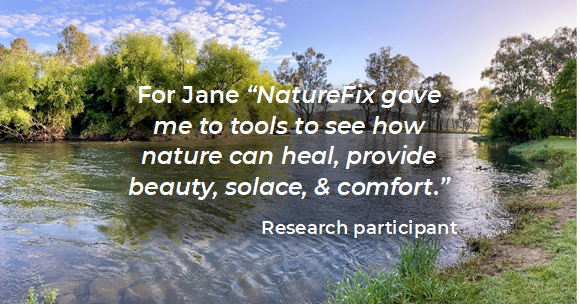
Twelve months later, Jane is back working full-time, hosting family gatherings and travelling overseas. She continues to use NatureFix practices in everyday life.
As well as qualitative data like this, the clinical trial tracks participants across three time points, including a waiting period before they begin the program. During that waiting period there was little movement across the studied seven validated wellbeing measures.
Following the six-week program, significant improvements were observed across all seven measures – including improvements in Warwick–Edinburgh Mental Wellbeing Scale (WEMWBS), the Flourishing Scale and Personal Wellbeing Index. And significant reductions in DASS-21 – Stress, Anxiety and Depression.
The trial is still underway, so these are interim findings and there is more to learn. But we're encouraged by what we're seeing.
Perhaps the most useful thing we've learnt so far is that there's an important difference between knowing that nature is good for us and having practical ways to use it. International research has found that it is the quality of the moment in nature that counts, not just the number of minutes.
Our mission has been to take the guess work out of how to create those elusive meaningful moments. It’s called the 5 Steps to Connect and is the basis of our program which is being tested in the clinical trial with NSW health.
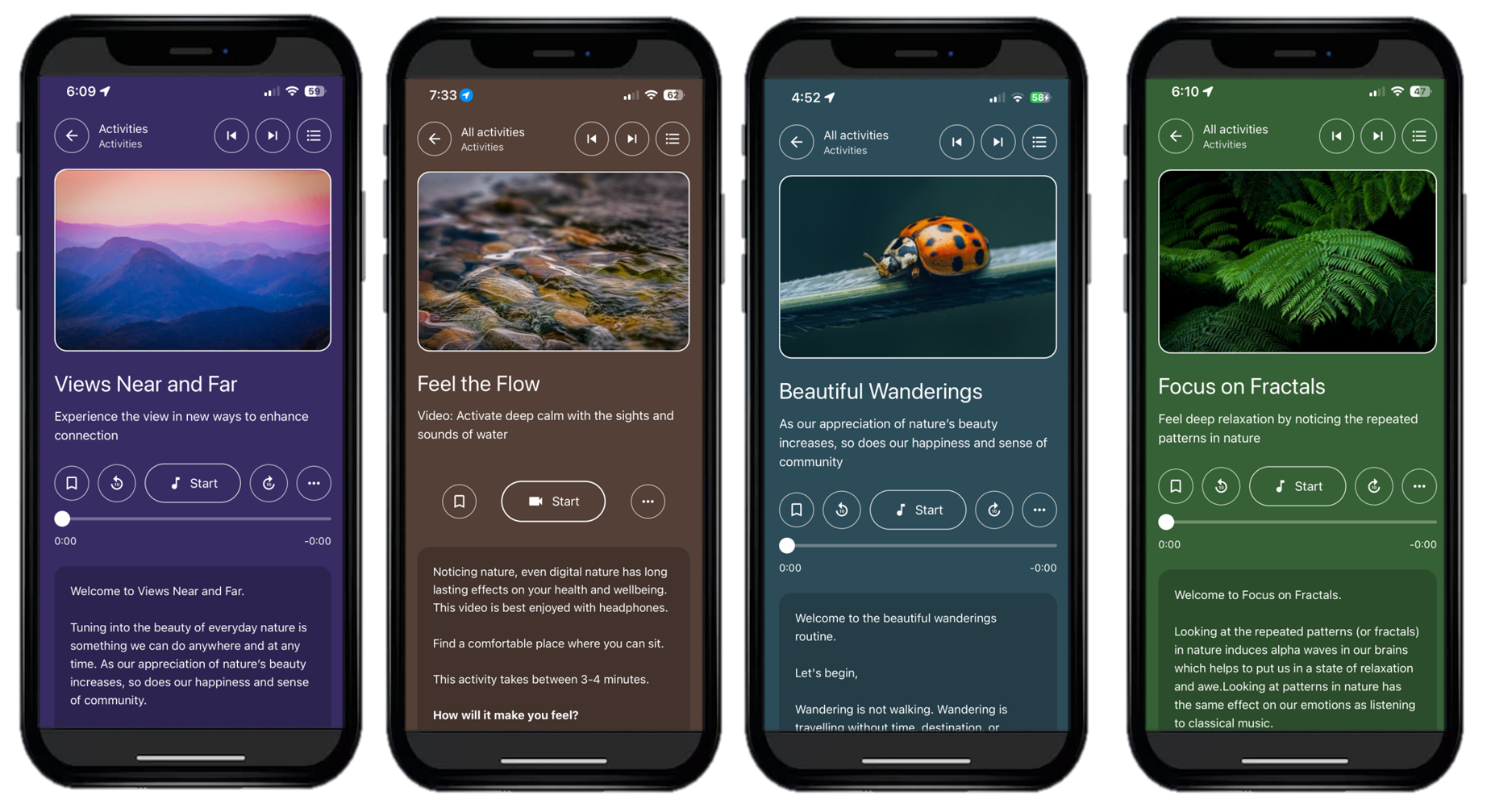
NatureFix provides guided nature connection activities as a structured program
This trial is being conducted with rural communities, but it’s important to say that the underlying mechanism - structured, guided engagement with nature – is appropriate in any setting where some nature is present. That includes hospital court yards, urban parks and gardens. It’s about improving the quality of engagement that matters, not just having a better view.
Our focus is turning what we are learning through research into practical, evidence-informed ways for people to access the health benefits of nature.
We are incredibly grateful to work alongside frontline health teams, including the passionate team at Murrumbidgee Local Health District, and privileged to collaborate with some of Australia’s leading researchers in nature and green prescriptions (thankful to Southern Cross and Charles Sturt Universities and the University of Wollongong).
Together, we are building the evidence and the practical tools to make nature-based health care more accessible, effective and scalable.
Because we firmly believe everyone deserves the opportunity to experience the health benefits of nature and everyone should know how to make the most of it.
We've put more detail about the research, the clinical pathway and Jane's case study into our Case Study for anyone interested in looking more closely at the work. Access full story HERE